

Application of Linear Displacement Sensor KTC in Bridge Monitoring
Application of Linear Displacement Sensor KTC in Bridge Monitoring
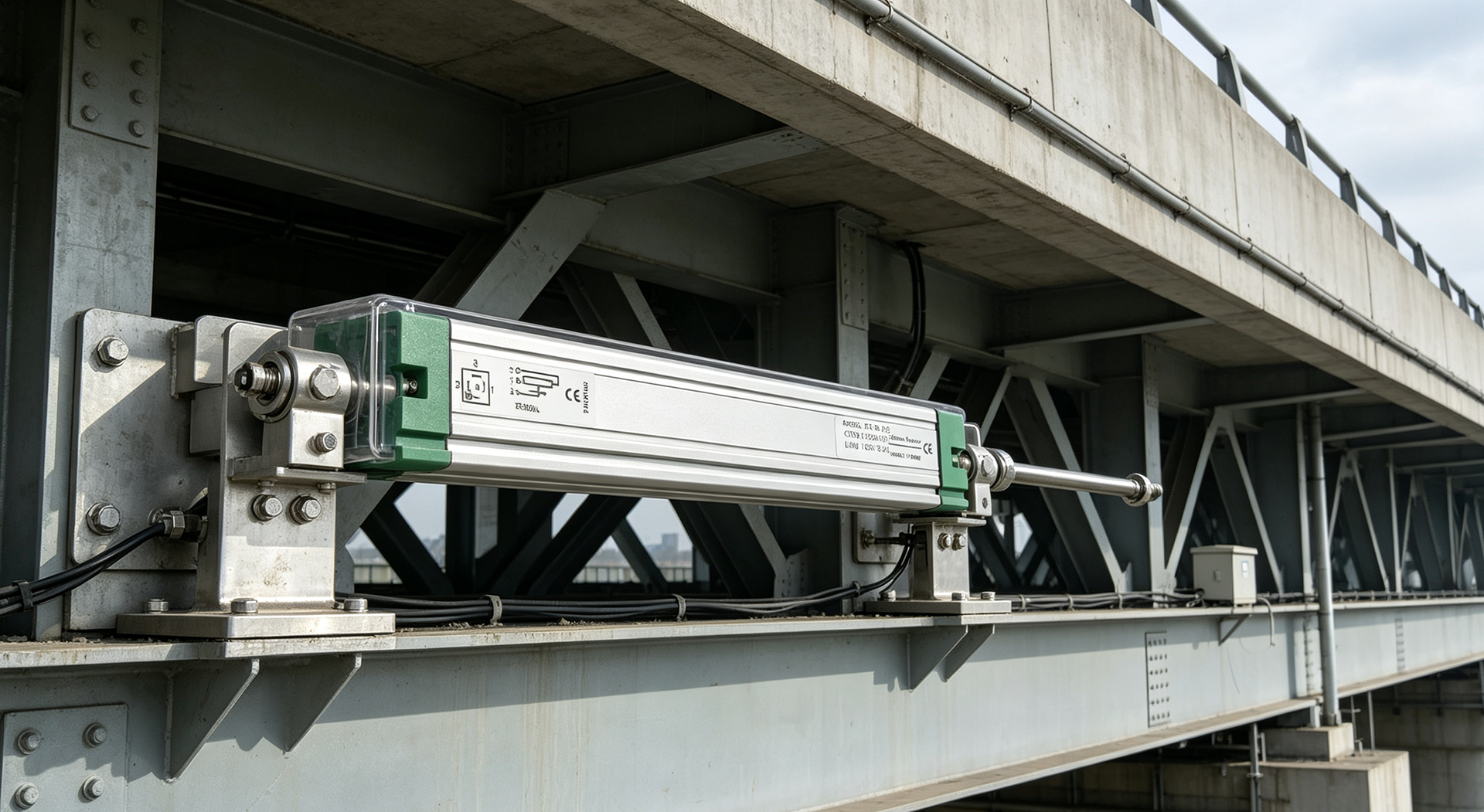
The KTC linear displacement sensor is installed between the bridge pier and the beam, and the tension rod follows the deformation of the bridge structure to collect data on beam displacement, expansion and contraction. It is connected to the lightweight monitoring system of the bridge and combined with a camera to achieve visual monitoring.
The role and advantages in bridge monitoring scenarios:
1. High precision capture of small structural deformations
Capable of high resolution, capturing millimeter level displacement changes, and continuously monitoring bridge expansion joint deformation, crack opening and closing, and support slip; Compared to traditional manual quarterly/monthly inspections, data can be collected continuously 24/7 to promptly detect structural changes caused by vehicle load, temperature, and aging. Risk warning is supported after exceeding the limit, and safety hazards can be identified in advance.
2. Strong installation adaptability, in line with the concept of lightweight monitoring
As shown in the figure, it is installed using bracket hanging, without the need for extensive slotting or dismantling of the bridge main body. The construction is simple and there is no need to close roads or cut off intersections; Easy disassembly and debugging, with targeted key points and fixed-point deployment, eliminating the need for large-scale deployment across the entire bridge, in line with the current "lightweight monitoring" focus on lesion points, reducing damage to the bridge body. The range selection is rich, and it can adapt to the expansion displacement range of different bridges. The outdoor bracket installation method is suitable for the complex installation space under the bridge.
3. Adapt to harsh outdoor engineering environments with good stability
The shell has undergone protective treatment and can withstand outdoor conditions such as sun exposure, temperature differences, wind, rain, and humidity; The mechanical structure of the pull rod is anti vibration and can withstand the continuous vibration interference caused by vehicle traffic, making it suitable for long-term use; The signal output is stable and can be connected to monitoring and acquisition devices to achieve remote data transmission to the platform.
4. Outstanding cost-effectiveness, reducing project construction and operation costs
Compared to high-end fiber optic sensing equipment, the purchase cost of pull rod electronic rulers is lower, the wiring is simple, the failure rate is low, and the maintenance workload is small in the later stage. This allows a large number of small and medium-sized bridges to deploy automated monitoring, changing the previous situation where only large bridges had health monitoring systems and facilitating large-scale promotion and implementation.
5. Multiple devices can be integrated and linked together
It can collaborate with monitoring cameras, inclinometers, and other devices, as shown in the picture, to synchronously deploy ball machine cameras on site. The displacement data and video images are linked. When there is an abnormal displacement alarm, the on-site images are retrieved for review, distinguishing between real structural defects and interference false alarms, and improving the reliability of the monitoring system.
The displacement sensors such as the pull rod electronic ruler have irreplaceable advantages in a large number of small and medium-sized infrastructure and fixed-point location monitoring scenarios. They are deeply integrated into smart transportation and smart infrastructure. They have developed from simply collecting displacement data to "sensing edge computing early warning and auxiliary maintenance decision-making", playing an important role in the field of infrastructure life-cycle safety monitoring.