

Application of spoke weighing sensor
Application of spoke weighing sensor
Spoke force sensor is also the most common sensor in our industrial practice. Because of its advantages of shock resistance, vibration resistance, high precision, high stability and wide working temperature range, it is widely used in many industries. So how much do you know about the main principles and principles of structural design of spoke force sensor? Next, let's understand the main principles and principles of structural design of spoke force sensor:
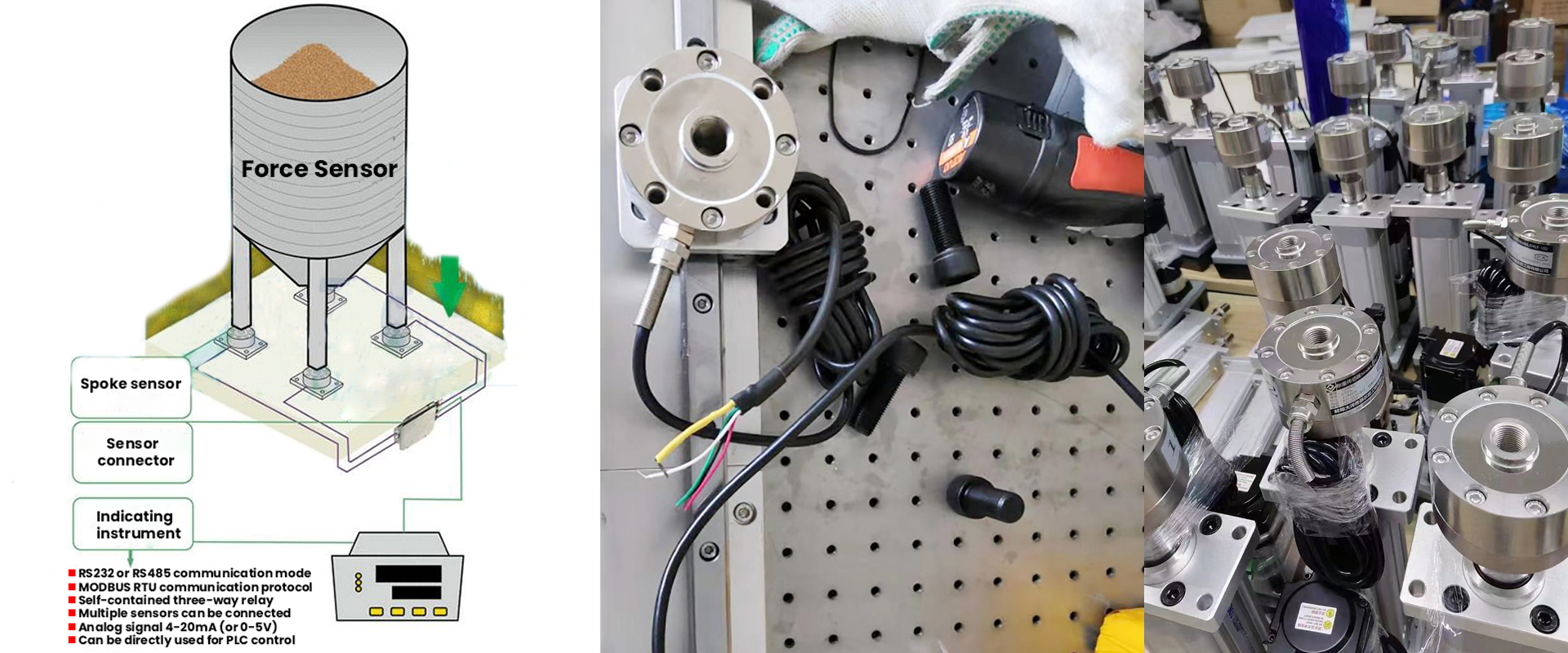
一、The main principles of structural design of spoke force sensor
1. Have good rigidity
In order to keep the working state of the sensor stable and reduce the influence of external vibration interference, the elastic displacement of the elastomer under load should be reduced as much as possible to make it have a higher natural frequency.
2. Have a simple and reasonable overall structure
Elastomer should be a whole, avoiding combined structure, reducing the influence caused by loose fastening, welding deformation, etc., and helping to simplify processing technology and reduce costs.
3. It is insensitive to the change of the position of the force and the influence of the interference force.
It is hoped that the stress distribution in the strain-sensitive area of elastic body will only change with the magnitude of the force.
4. The technological performance of the elastomer working area is good, including good machining, pasting and sealing installation processes.
5. It has low profile structure, convenient installation and good bean interchangeability. The low-profile structure can enhance the lateral force resistance and make the working state stable.
二、 The principle of spoke force sensor
Because its shape is like a wheel with spokes, we call it a spoke sensor. Because its basic principle is to measure shear stress, it is also called a shear stress sensor. Because of its low height, it is also called a low-profile sensor abroad. The outstanding advantages of this sensor are low height, high precision, good linearity, strong ability to resist eccentric load and lateral force, etc. It can be used to measure both pressure and tension.