

Benefits and Advantages of Twin-impeller Side-channel Blowers in Wastewater Aeration
Benefits and Advantages of Twin-impeller Side-channel Blowers in Wastewater Aeration
Modern wastewater treatment plants are judged by two yardsticks: the quality of the effluent and the size of the electricity bill. The twin-impeller side-channel blower, epitomised by the 2LG720-7HH26, addresses both challenges in a single, compact package. With two dynamically balanced impellers mounted on one shaft, the unit behaves like two blowers in series, generating a continuous, pulse-free flow that dissolves oxygen far more efficiently than conventional single-stage machines.
The first advantage is energy efficiency. The 2LG720-7HH26 delivers 385 m³/h at 260 mbar with only 3 kW, translating into an oxygen-transfer rate roughly 30 % higher per kilowatt than traditional Roots blowers. Over a year this can shave 20-35 % off the aeration electricity bill, the largest single operating cost in most plants.
Secondly, the dual-impeller design creates a steadier discharge pressure, so fine-bubble diffusers receive uniform air. Uniform air means uniform dissolved oxygen, which prevents the dead zones that cause filamentous bulking and guarantees full nitrification even when influent ammonia fluctuates. Operators report DO set-point deviations below ±5 %, a figure that manual valve throttling can rarely match.
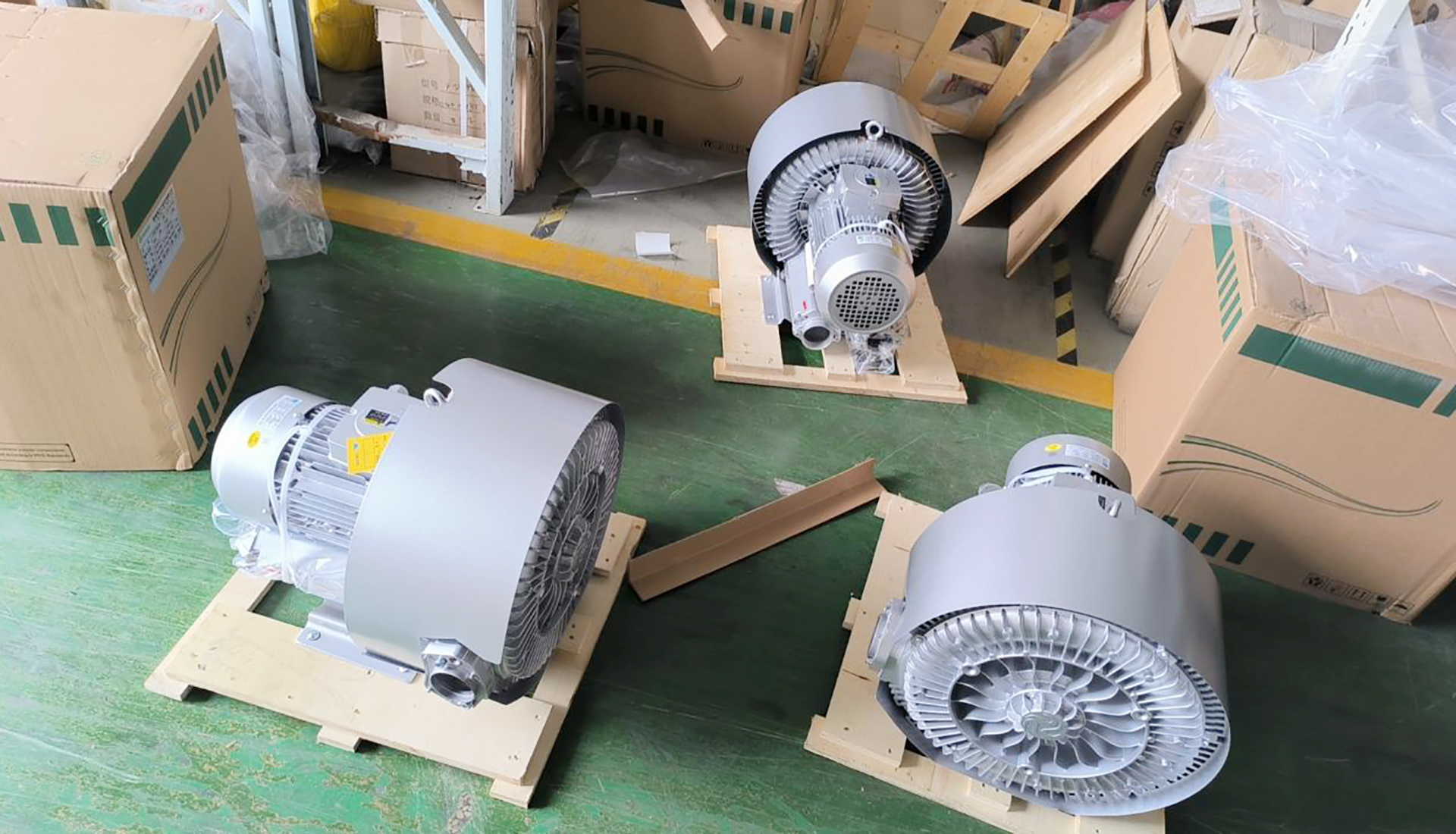
Thirdly, the blower excels in variable-duty service. Because the motor is wound for both 50 Hz and 60 Hz, the same machine can be soft-started, frequency-controlled or simply run across regional power grids without rewinding. When paired with a dissolved-oxygen probe, the 2LG720-7HH26 can follow a PID loop in real time, trimming airflow the moment oxygen rises above 2 mg L⁻¹ and adding air within seconds when loading spikes. This responsiveness protects the biology and avoids the “over-aeration tax” paid every month on the power invoice.
Maintenance advantages are equally persuasive. The aluminium casing weighs only 47 kg, so one technician can slide the blower aside without a forklift. There are no lubricated timing gears, no oil mist separators and no reciprocating seals; only two sealed-for-life ball bearings need attention, and even those are rated for 20 000 hours. Annual consumable costs drop to roughly one third of those for oil-flooded screws or classic lobe machines.
From a process-design viewpoint, the 260 mbar maximum pressure allows the blower to serve tanks up to 5 m deep while still reserving 20 % head-room for fouled diffusers or seasonal level rise. The –280 mbar vacuum side is a bonus: the same unit can be valved to pull sludge gas through a digester mixing loop, eliminating a separate biogas compressor in small facilities.
Noise and footprint, often the Achilles heel of aeration equipment, are minimal. The twin impellers rotate at only 2 800 rpm, generating sound levels below 70 dB(A) at 1 m—quiet enough for indoor installation without acoustic enclosures. With a 2-inch inlet/outlet, piping losses are low and standard schedule-80 PVC can be used, cutting capital cost still further.
Finally, the technology future-proofs the plant. Stricter nutrient limits and carbon taxes are inevitable; a blower that already delivers 2.8 kg O₂ kWh⁻¹ gives operators head-room to meet tomorrow’s effluent standards without buying bigger hardware. In short, the 2LG720-7HH26 twin-impeller side-channel blower turns the largest energy consumer in wastewater treatment into its most efficient ally, combining robust construction, precise control and low life-cycle cost in one 47-kg package.