
Precision Without Friction: Why SOP Sensors Thrive Where Others Quit
Precision Without Friction: Why SOP Sensors Thrive Where Others Quit
In the world of precision measurement, there is a fine line between a "data point" and a "data disaster."
Most displacement sensors perform well in a clean lab. But your equipment doesn't live in a lab. It lives in the real world—where vibration is constant, temperatures fluctuate, and dust is everywhere. This is where the "cheap alternatives" reveal their true cost.
The Physics of Failure vs. The Engineering of SOP
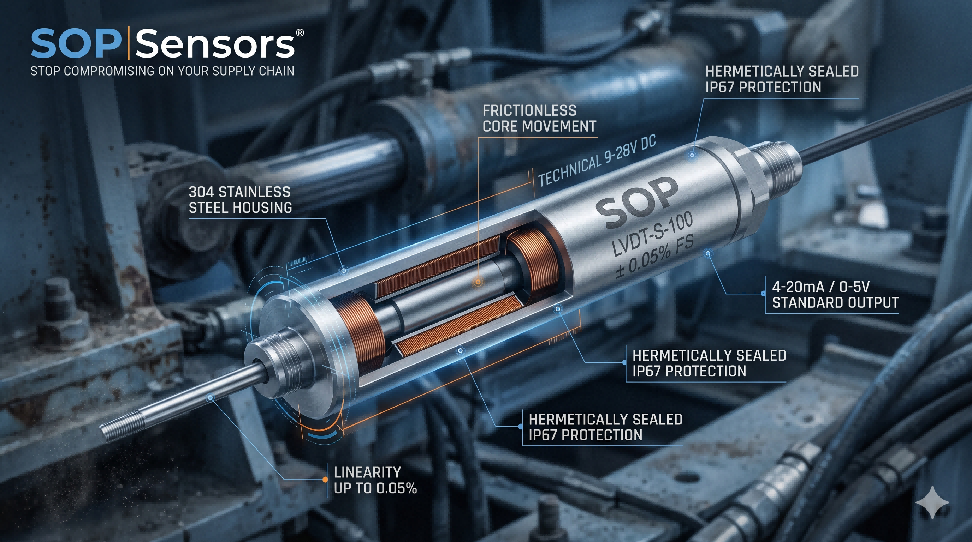
Why do most contact-type sensors fail after 6 months? Friction. At SOP, our LVDT (Linear Variable Differential Transformer) sensors are built on a frictionless core movement principle. No contact means no wear. No wear means a mechanical life that is virtually infinite.
While others use aluminum or plastic housings to cut costs, we insist on 304 Stainless Steel. Why? Because in high-vibration or corrosive environments, structural integrity is the only thing standing between a successful measurement and a total system shutdown.
We don't hide behind vague marketing terms. We lead with the numbers:
1. Signal Integrity:protection to ensure your PLC receives clean data, even in electrically noisy environments.
2. IP67 Sealing: Our sensors are designed to be hermetically sealed, protecting the delicate internal coils from the ingress of moisture and micro-particulates.
18 Years of Battle-Tested Experience
Founded in 2002, SOP has spent nearly two decades solving the "impossible" measurement problems. With German-sourced technology integrated into our China-based manufacturing hub, we offer the rare combination of European precision standards and the supply chain agility of a direct factory.
We aren't just selling you a component; we are eliminating a failure point in your supply chain. Whether you are measuring the minute deflection of a bridge or the stroke of a massive hydraulic press, SOP provides the certainty you need.
Stop measuring by hope. Start measuring with SOP.