

The construction of centrifugal fans can be classified in the following ways
The construction of centrifugal fans can be classified in the following ways:
1. By the outlet angle of the impeller blades (the most core classification):
- Forward-curved fan: The blades curve forward, with an outlet angle greater than 90 degrees. It has high wind pressure, a compact structure, but relatively low efficiency and high noise. It is suitable for ordinary ventilation scenarios with low noise requirements.
- Backward-curved fan: The blades curve backward, with an outlet angle less than 90 degrees. It has high operating efficiency, low energy consumption, low noise, and a stable operating curve. It is the mainstream efficient choice in industrial fields.
- Radial fan: The blades are in a radial straight plate shape, with an outlet angle equal to 90 degrees. It has a sturdy structure, is resistant to wear, and is easy to clean. It is often used for conveying particles, fibers, or corrosive gases.
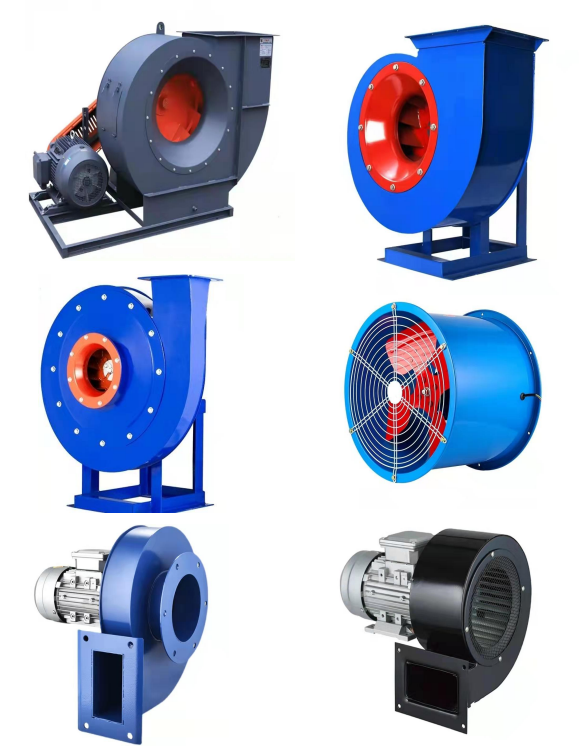
2. By the intake method:
- Single suction type: The intake port is only on one side of the impeller. It is the most common and simple structure.
- Double suction type: Both sides of the impeller have intake ports. Under the same impeller size, it can provide approximately double the air volume, suitable for large air volume and low pressure systems.
3. By the transmission method:
The transmission method determines the connection form between the motor and the impeller, directly affecting installation and maintenance. The international standard mainly includes forms such as A, B, C, D, E, and F. Common ones include:
- Type A: Direct motor transmission. The impeller is directly installed on the motor shaft. The structure is the most compact, with a transmission efficiency of 100%, and is often used for small fans.
- Types B, C, and E: All are belt transmission. Through belt pulley speed adjustment, the fan speed can be flexibly adjusted to adapt to different working conditions. However, there is energy loss in the transmission, and the belts need to be regularly maintained and replaced. The differences lie in the layout positions of the motor and bearings (such as cantilever support or both sides support).
- Type D: Coupling transmission. The motor is connected to the fan shaft through a coupling. The fan shaft is supported by its own two sets of bearings. This structure is stable, can transmit large torque, and is suitable for large high-pressure fans.
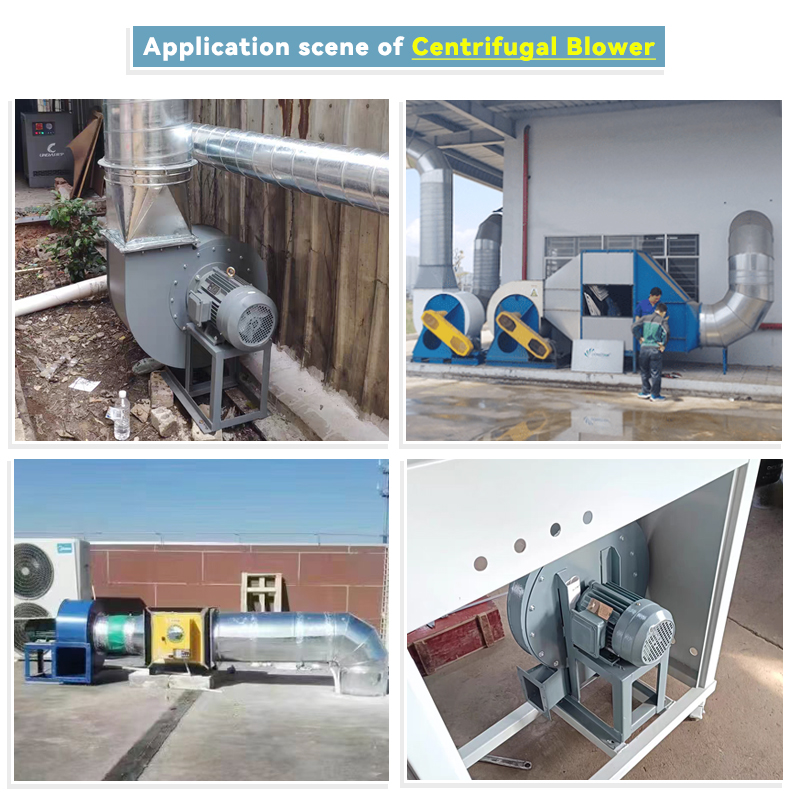
4. By pressure level classification:
- Low-pressure centrifugal fan: The total pressure is lower than 1000 Pascals, often used for ventilation and air exchange.
- Medium-pressure centrifugal fan: The total pressure is between 1000 and 3000 Pascals, often used in air conditioning systems or pipe network supply and exhaust ventilation.
- High-pressure centrifugal fan: The total pressure is higher than 3000 Pascals, up to tens of thousands of Pascals, used for process transportation, material drying, etc., requiring overcoming significant resistance.
5. Other structural features:
- Rotation direction: From the side of the motor looking in, the impeller rotates clockwise as "right-hand" and counterclockwise as "left-hand". It must be specified during ordering.
- Outlet direction: The fan casing outlet can be designed to face multiple fixed angles (usually 8 basic directions) or adjustable angles.
- Key component forms: Such as the inlet port having cylindrical, conical, or arc-shaped various collectors, among which the conical and arc-shaped ones have the best efficiency; the fan casing having integral and detachable types, etc.
When choosing which type of fan, it is necessary to comprehensively consider the required air volume, wind pressure, medium characteristics, installation space, efficiency requirements, noise standards, and maintenance costs.